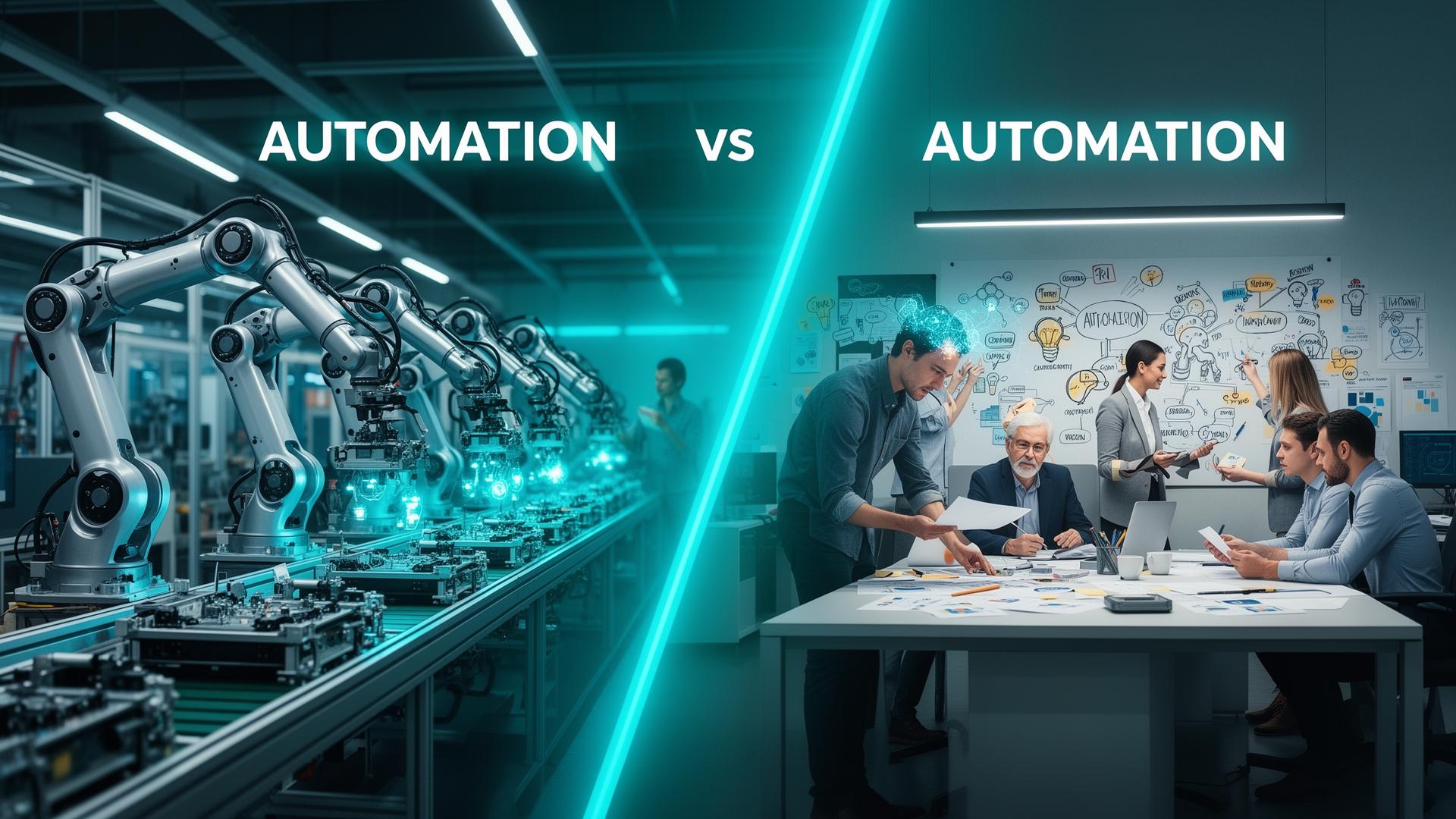
Most companies approach AI as a tool for automation-replacing manual tasks with machines to cut costs. But the real winners are those who see AI as a catalyst for transformation, fundamentally reimagining how they create and deliver value.
The Automation Trap
The automation mindset sounds logical: identify repetitive tasks, apply AI, reduce headcount, save money. But this approach has a fundamental flaw-it optimizes for the present, not the future.
❌ Automation Mindset
- • "How can AI do what we already do, cheaper?"
- • Focus on cost reduction
- • Incremental improvements
- • Defend existing market position
- • Technology-led implementation
✓ Transformation Mindset
- • "What can AI enable that was impossible before?"
- • Focus on value creation
- • Step-change innovations
- • Create new market opportunities
- • Strategy-led implementation
The irony: Companies that pursue only automation often get disrupted by newcomers who leverage AI transformatively to redefine customer expectations entirely.
Three Levels of AI Impact
Understanding the hierarchy of AI impact helps organizations aim higher:
Efficiency
Doing the same things faster and cheaper. Automating data entry, document processing, basic customer service.
Effectiveness
Doing things better than before. Personalized recommendations, predictive maintenance, intelligent decision support.
Transformation
Doing entirely new things. New products, new business models, new markets that didn't exist before AI made them possible.
Real-World Examples
Insurance: From Claims Processing to Risk Prevention
Automation: Use AI to process claims faster.
Transformation: Use AI to predict and prevent incidents, shifting from reactive claims to proactive risk management-creating entirely new service offerings and revenue streams.
Manufacturing: From Quality Control to Product Innovation
Automation: Use AI to detect defects on the production line.
Transformation: Use AI to design new products, optimize for sustainability, and create personalized manufacturing at scale.
Retail: From Inventory Management to Experience Design
Automation: Use AI to forecast demand and optimize stock levels.
Transformation: Use AI to create hyper-personalized shopping experiences, predictive commerce, and new subscription-based business models.
The Strategic Questions
Before launching your next AI initiative, ask yourself:
"Are we using AI to protect our current business, or to create our next one?"
"What becomes possible with AI that was impossible without it?"
"How would a startup with no legacy use AI to disrupt our industry?"
"What new value can we create for customers that justifies premium pricing?"
The Bottom Line
Automation is necessary but not sufficient. While you should absolutely pursue efficiency gains, don't let automation become your AI strategy.
The companies that will thrive in the AI era are those that use it to transform-to create new products, enter new markets, and deliver value in ways that weren't possible before. That's where sustainable competitive advantage lives.